Immigration has been a major issue with few avenues of hope for the 11 million undocumented immigrants in the U.S. In light of President Obama’s recent announcement on reform plans, it has come a step closer to the forefront of national attention.
A temporary resolution for an ongoing demand has been reached. The question no longer seems to be about whether the millions of undocumented individuals residing in the U.S. will be shielded from deportation, as much as it is a matter of how soon.
After a formal address on the new executive measure was televised, it made headlines on every major news outlet – that about 5 million undocumented individuals could put their worries of deportation to rest.

Undocumented is what they are called, but voiceless they are not. Jong-Min You, a Korean American, is one of them.
Jong-Min, 34, is an immigration activist based in Brooklyn. He’s been helping his parents run a local grocery store in Bensonhurst for the past 20 years. He was a year old when he came to the US in 1981, and a year too late to be eligible for Deferred Action for Childhood Arrivals (DACA) in 2012. He missed the age limit of 31 by a year – he was 31 years and 11 months old, to be exact.
Now, with age restrictions lifted, he has another chance.
“It’s just an idea. When it opens up, I can apply,” said Jong-Min.
Jong-Min is referring to DACA expansion, a process that will involve applications from about 4 million qualifying undocumented individuals. According to the USCIS website, it is one of the components of a two-part measure that will take effect 90 days after the President’s Nov. 1, 2014 announcement.
And there is Deferred Action for Parental Accountability (DAPA). It protects an undocumented immigrant parent with a U.S.-born child, or a child that holds legal, permanent resident status from deportation. Applications for DAPA will open around mid-May, 2015.
When DACA was first introduced in 2012, government estimated about 1.2 million undocumented immigrants to apply, but only half that number became actual beneficiaries.
The age limit, lack of finances, and criminal records, especially prevalent among teens, are possible factors that account for the low turnout. The application fee for DACA is about $500, and non-English-speaking households are often required to hire lawyers for representation. In immigration law, shoplifting something of minimal value or minor vandalism is defined as a petty offense for juvenile convictions.
A record 1.5 million undocumented immigrants were deported under the current administration. Since President Obama took office, about two-thirds of nearly 2 million deportation cases involve people that committed minor infractions, including traffic violations, or had no criminal record at all, according to a New York Times analysis.
“About 600,000 people got approval,” said Yu Soung Mun.
Yu Soung Mun is Secretary-Treasurer at MinKwon Center, a Korean American community-based organization located in Flushing, NY, where there is a large population of ethnic Koreans.
“Top priority at our center has been for immigrants since the early ‘90s,” said Mun. “We think that justice for immigrants is the most important issue for all countries in the 21st century.”
According to 2014 statistics released by Pew Research Center, a vast majority, roughly 80%, of unauthorized immigrants in 2012 were born in Latin America. The other 20% were from regions including Asia, Europe, Canada, the Middle East, and Africa.
At a campaign on Nov. 21, a crowd of mostly Latino high school students heard the President’s challenge on Congress to pass a bill that would address what he called the nation’s broken immigration system.
“I think that it’s very difficult to see major changes. It took 28 years,” said Mun.
The last time changes were made to immigration law was in 1986, with the passage of an amnesty bill under President Reagan’s administration. While the Immigration Reform and Control Act implemented tighter border security, and a penalty for employers that hired undocumented workers, it also allowed individuals that arrived before 1982 to remain legally in the US. As a result, amnesty was granted to about 3 million who were considered to have lived in America long enough to call it their home.
According to Pew Research Center, Korea ranked eighth among countries with the largest number of unauthorized immigrants in 2012, accounting for about 180,000 people.
“The Korean community has the highest undocumented population rate among Asian ethnic groups,” said Mun. “About 14% of the total number of Koreans living in the U.S. are undocumented.”
But how is it that we seldom hear about their stories?

“Korean people usually don’t like to disclose their status. It’s something that’s a taboo between people, something they feel shame about,” said Jung Rae Jang.
There is a cultural explanation, but like all other undocumented individuals, regardless of ethnicity, fear is the main factor that causes them to hide. The culture of fear is what drives them behind the shadows of society.
Jung Rae Jang decided that that wasn’t going to solve anything, and chose to speak out.
“Even though MinKwon is very active in immigration advocacy, I don’t see many other Korean organizations that do the same thing, compared to what Latino organizations do,” said Jang. “That’s why people think this is a Latino issue.”
Jang is a senior at Baruch College. He came to the U.S. at age 15 with his mother, and graduated high school in Georgia. Thereafter, he moved to New York for better prospects of getting a formal university education, and to avoid strong anti-immigrant sentiment in the South.
“I was taking all the AP classes, honors classes. I was doing my best in school, I can say,” said Jang. “Despite the fact that I felt like I deserved it, I still didn’t get a chance to apply for school in Georgia.”
Georgia is one of three states that bars undocumented students from attending public colleges. Arizona and Indiana are the other two.
Several states across the country, including Georgia, Alabama, Indiana, South Carolina, and Utah have enacted copycat laws that follow the model of Arizona’s SB 1070, which allows local police officers to stop anyone and ask about an individual’s immigration status.
“It’s not a Latino issue. The Korean community gets affected by it as well,” said Mun.
Jong-Min You was affected by it his entire life.
“I hear comments all the time, because not everybody thinks I’m undocumented,” said Jong-Min. “They don’t assume that with me because I’ve been here for so long, and I speak English well. So people might not understand that.”
Jong-Min graduated from the University of Tennessee, Knoxville in 2002. For 11 years, he waited for the Development, Relief, and Education for Alien Minors (DREAM) Act to pass. He did not qualify for temporary status relief because he had aged out. That meant not being able to get a driver’s license, travel abroad, or apply for jobs of his choice.
“When I’m working at a grocery store with my college degree, there’s that judgment – ‘Why didn’t you do better than this?’ said Jong-Min. “Those questions came throughout the years, but a lot of people didn’t know my situation.”
Jong-Min is studying to take the LSATS next year. His dream is to become a federal judge.
“Hopefully, this new DACA program is the first step moving forward. Federal judges need citizenship, so it’s still not clear if I could.”
Jong-Min graduated from Stuyvesant High School, one of nine specialized high schools in New York City. He was an exceptional student, but the promise of a bright future was darkened by an event he recalls from 2007.
“That was a big blow.”
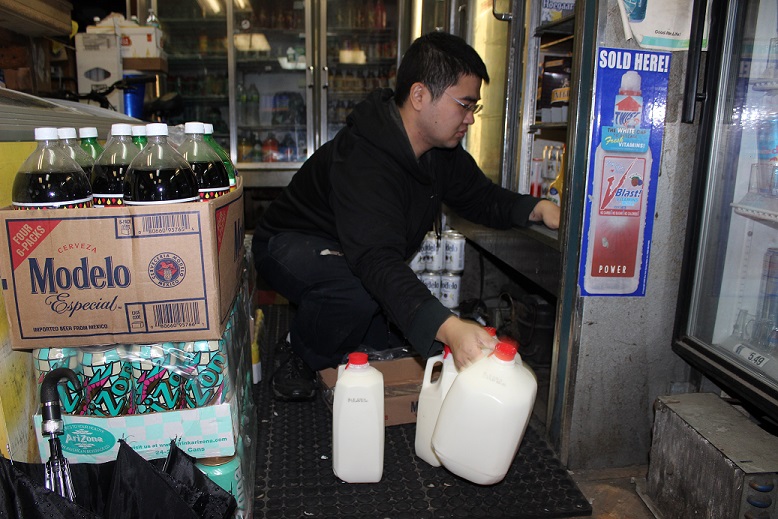
Jong-Min was applying for a hospital residency program. At the time, he was considering a career in pediatrics.
“I was at the hospital and they wanted my green card. I went to the grocery store. I asked ‘Where’s my green card?’ and my mom said it was at the house. I went back home trying to find this magical green card, and I could never find it,” he said. “And I went back and asked ‘Where’s my green card?’ again, and my mom said ‘You don’t have one, Jong-Min. You can’t do that hospital program.’”
For Jang, realizing his status wasn’t as shocking, but living with the realities of it was just as unfriendly. Jang came to the U.S. on a tourist visa at age 15. He was old enough to know that the visa would eventually expire in a year, leaving him undocumented.
However, Jang was able to apply for DACA in September 2012, and got approved in December that year. He applied for renewal of temporary status and was successful. Jang is able to work legally in the U.S. and is shielded from deportation.
“I feel relief, in a way,” said Jang.
Because of DACA, Jang can continue to work at the legal office where he is now. He shares two of the happiest moments in life —
“First was when I got my work permit. The second was when I got my W-2 so that I could file my taxes – that really means that I’m part of society.”
While DACA provided great opportunities for Jang, it came as a disappointment for his mother, who is not eligible for DAPA.
“My greatest fear is that one day, I’m gonna hear from her – that she’s in some detention center upstate in deportation proceedings,” said Jang.
Yu Soung Mun has been working full-time at the MinKwon Center for the past 24 years.
“I clearly see all the hardships of the marginalized. How can I stop working for something that requires a lot of effort?”
He closely monitors the progress of immigration, and says that President Obama’s announcement is a hopeful sign, the most significant change in regards to immigration policy in almost 3 decades.
“But it’s temporary,” said Mun.
The impermanent nature of a president’s executive order reminds the undocumented community that things remain a question for them in the future.
“It’s the uncertainty that bothers you. You don’t know what’s going to happen tomorrow,” said Jang.
The MinKwon Center projects that in the New York Area, about 10,000 – 15,000 Koreans will be eligible to apply for temporary status relief, and nationwide, about 100,000.
“We are Americans, in a sense, it’s just that we don’t have the paperwork right now,” said Jong-Min.