Letters to My Hometown
Letters to My Hometown: Kim Rogers Family
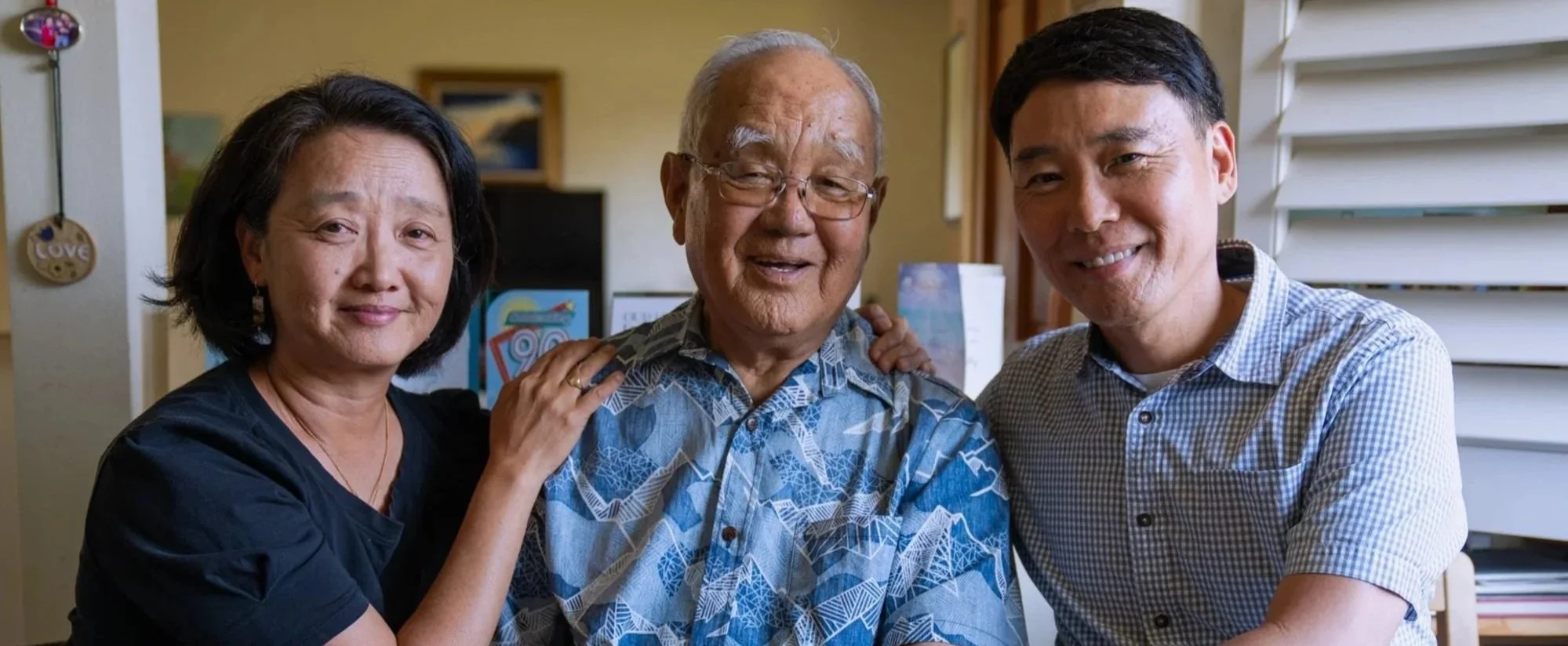
Tae-hyok Kim is joined by his children, Michelle and Harold, as well as his granddaughter Nicole, in a conversation on the archival, therapeutic, and familial importance of passing down stories. For Tae, the story began seventy-seven years ago when he left his village, Cheong-duk-gol, for Seoul, not realizing that his departure from home would become permanent amidst the backdrop of the Korean War. Embedded into this story are accounts of cold, harsh winters which prevented his family from collectively crossing into the South, alongside memories of home-cooked meals shared with family in his rural farming community.
Letters to My Hometown: Yun Family
Won Yun is joined in conversation by his daughter-in-law, Cristina, and his granddaughter, Emily, in a reflection on the enduring cost of war and the fragile threads of family connection. Born before the outbreak of the war in North Korea, Won’s childhood in Pyongyang was a landscape of contrast, where the joy of skating on the frozen Daedong River was eventually eclipsed by the nightly raids of the Korean War.
Letters to My Hometown: Kwon Family
In a conversation between parents and daughter which is at once raw, poignant, and hopeful, Rosa Kwon sits down for a heart-to-heart with her parents, David and Jean Yoon Kwon, to navigate the untranslated geography of their family’s history.
Letters to My Hometown: Lee Family
Ninety-year-old Chang Soon Lee sits before a computer to write a letter to the father he hasn’t seen in seventy-five years, a man who remained a distant but precious memory after their separation during the Korean War. Joined by his children, Bora and Bob, Reverend Lee recounts the deep-rooted courage of his own father—a minister who defied Japanese authorities to protect his parish—while grappling with the silence that defined his family’s history.
Letters to My Hometown: Jun Family
Gil Sung Jun is joined by his daughter, Grace, for a conversation on how love is transmitted and received within families burdened with traumatic histories of war.
Letters to My Hometown: Kim Family
Vana Kim is joined in conversation with her daughter and granddaughter, Una and Hana, as they reflect on their family’s history of exile and how the legacy of division reverberates through generations.
Letters to My Hometown: Roh Family
Haesoon Koh and Moohong Roh are joined in conversation by their son, Michael, in reflections on his grandparents, who were separated from their families during the Korean War.
Hyung Chang Kim
Hyung Chang Kim recounts the memories of his father, the late Gi Suk Kim, who was born in 1926 in Namcheon-ri, Eunyul-gun, Hwanghae Province which today is located in North Korea. Gi Suk Kim had been a teacher when the Korean War broke out, but as an act of resistance against the mandatory rules carried out by the People’s Army, he joined the Guwolsan Guerilla Unit (part of the KLO), an American-led guerilla warfare unit whose soldiers took commands from American military officials. He, alongside some of his colleagues, had come under suspicion by the North Korean government for their anti-communist activities, and were captured and imprisoned; it was through the saving grace of his uncle, a high-ranking official in the North Korean government, that Gi Suk Kim narrowly avoided execution. After the end of the Korean War, his unit remained in operation in Jirisan, where he was told North Korean operatives were in hiding, to suppress the operations of remnant forces. He eventually settled in Uijeonbu, Gyeonggi Province, where he had Hyung Chang Kim, the eldest of three sons and two daughters. Hyung Chang Kim recalls his father’s acute longing for his hometown, often taking his son to accompany him on visits to the Hwanghae Province Central Residents’ Association, or the Northern Five Provinces Committee, while he reminisced with other Koreans whose hometowns were in the North of their childhoods. Though he had been healthy for his entire life, his father passed suddenly at the age of 60, having spent much of his later life longing for his home, and regretting that reunification couldn’t happen sooner. Hyung Chang Kim, who is now older than his father was when he passed, has inherited the deep sorrow caused by ideological divisions between the North and South. He wishes to meet his family in Hwanghae one day, greet them on behalf of his father who spoke of them often, and hopes that they remain healthy so that he might visit as soon as he can.
Jung Sook Han
Jung Sook Han was born on August 2nd, 1935, in Pyeonggang County, Kangwon Province, Korea. Her father was a schoolteacher who was regarded highly by his community, and she grew up with older siblings as well. She remembers fondly her oldest sister as well as her brother-in-law, for whom she’d act as a courier of sorts, delivering messages and love letters between the two. Growing up in the highlands of Pyeonggang in a township called Sepo, Jung Sook and her family would farm radishes and beans which grew abundantly in the alpine climates of the Taebaek Mountains. She recalls how her brother-in-law would often shake chestnuts—a Kangwon-do staple—out of their trees as she sat under them. When Jung Sook was ten years old, she and her family moved to Hongcheon county, a county in the southern part of Kangwon (sk: “Gangwon”) Province, while her sister stayed in Pyeonggang with her in-laws. Though she received word that her sister had had a child, she never met her niece or nephew; a couple of years later, she visited her hometown with a friend to find that her childhood home had been replaced by farmland, her sister and brother-in-law gone. She did manage to find her sister’s father-in-law, who told her that the young couple had been taken further north by North Korean soldiers. Although she has accepted that she may never see her sister or her brother-in-law again, she holds out hope that she may one day meet her sister’s child in a unified Korea. She wishes to tell them where they’re from, and that they should always love and protect their country so that it—and they—never be separated again.
This interview was filmed on July 31st, 2023 in Duluth, GA.